Economics Class 15
A BRIEF OVERVIEW OF THE PREVIOUS CLASS (05:01 PM)
REDUCTION IN EXPORT SUBSIDIES (05:05 PM)
- Apart from domestic subsidies, Developed countries also give export subsidies to enable their farmers to export their agricultural products at lower prices which makes the competition tougher for the Least Developed Countries' farmers.
- The Agreement on Agriculture requires developed countries to reduce their export subsidies by at least 30 percent by value or by 21 percent by volume over a period of 6 years. For developing countries, the reduction commitment is 24 percent by value or 14 percent by volume over a period of 10 years.
- Example/case study- Issue related to Sugar. In 2019, sugar cane production started increasing, this increased the sugar in the market. This also led to a fall in the prices of sugar. Sugar mill owners started making losses. They were not giving the guaranteed price i.e. Fair and Remunerative Price (FRP). FRP has legal backing.
- Then the Government started giving export subsidies so that excess sugar can be exported. Brazil filed a dispute against India in WTO.
- India's argument was that it was logistic-related and marketing-related subsidies. These are not product specific.
-
Anti-dumping duty Special additional Duty Additional custom duty or Countervailing duty- To handle excess subsidies given by another country Basics custom duty - If there is more excise duty in India then the domestic manufacturers will end up paying more than the foreign investors.
- Structure of WTO
-
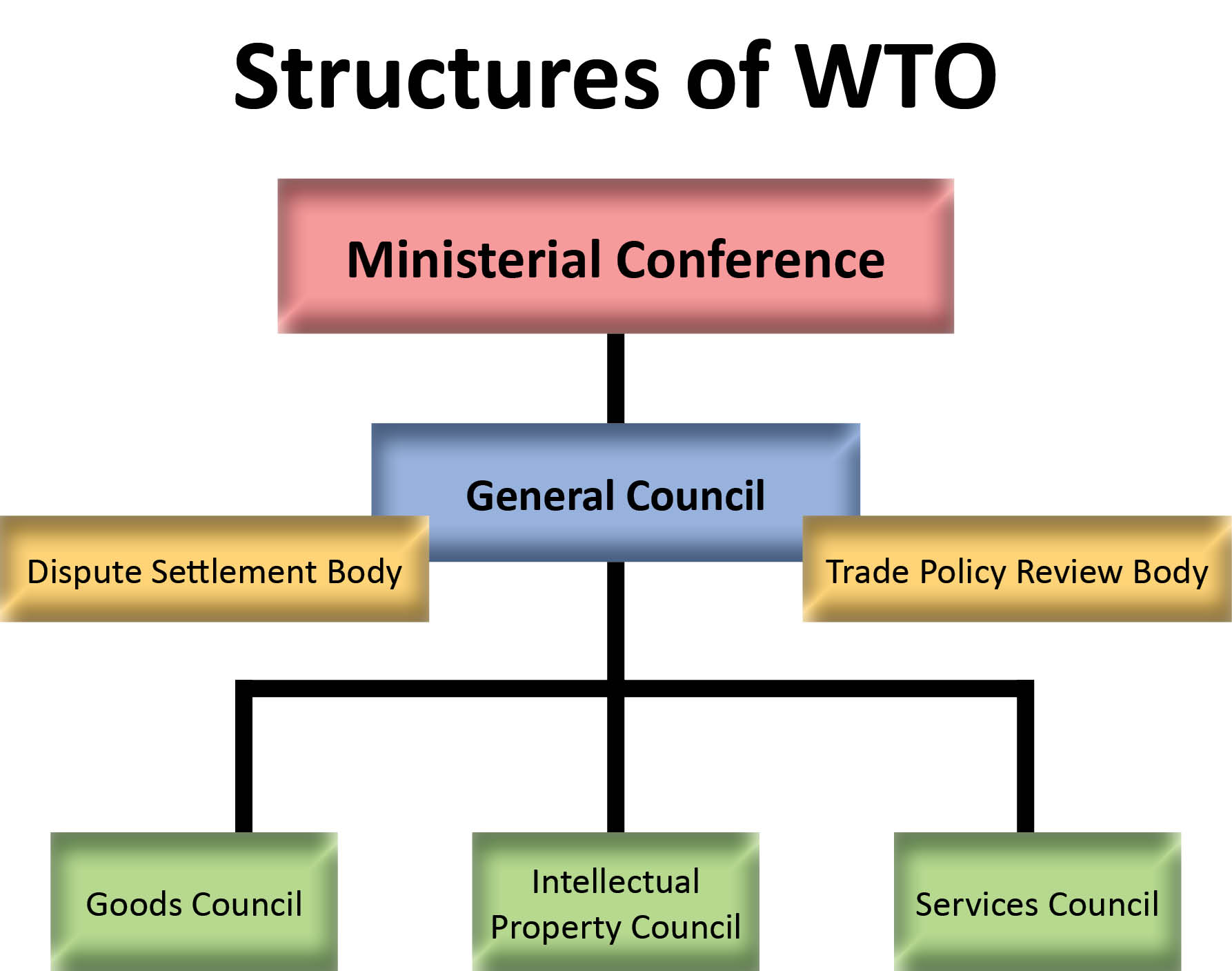
- When a case goes to a dispute settlement body then sets up the dispute settlement Panel. And it comes out with the judgment. A country can appeal the judgment at the Dispute settlement appellate authority (These are technical judges with a 4-year term and they can be reappointed based on consensus, they are 7 in number).
- Since 2005, the USA was continuously blocking the appointment of judges.
IMPROVED MARKET ACCESS (05:56 PM)
- Market access refers to the abolition of excessive non-tariff barriers in agriculture and converting them to tariff barriers. Subsequently, it also requires progressive reduction of tariff barriers also.
- Developed countries are required to reduce their tariff line by 36% in 6 years and the corresponding reduction commitment for developing countries is 24% for 10 years.
- Structure of WTO
- Ministerial conference
- The highest decision-making body in WTO. Which usually meets every 2 years.
- The ministerial conference can take decisions on all matters under any of the multilateral agreements.
- [* Plurilateral agreements- Which is a specific segment for some country For example- For LDC ]
- The first ministerial conference took place in 1996 in Singapore
- General Council
- It has ambassadors from all member governments and has the authority to act on behalf of the ministerial conference.
- The general council also meets as a dispute settlement body and trade policy review body.
- Dispute Settlement Body
- The general council convenes as the dispute settlement body to deal with disputes between WTO members. Such disputes may arise w.r.t. any agreements contained in the final act of the Uruguay round.
- The dispute settlement body focuses on
- 1) Establishing dispute settlement panels.
- 2) Refer matters for arbitration.
- 3) Adopt panel/ appellate body/ arbitration reports.
- 4) Maintain surveillance over the implementation of recommendations and rulings.
- Appellate body
- It was established in 1995. Dispute settlement bodies should appoint persons to serve on the appellate body for a 4-year term. It is a standing body of 7 members that hears appeals from the reports issued by the panel with respect to disputes brought by WTO members.
- The Appellate Body report once adopted by the dispute settlement body must be accepted by the parties of the dispute.
- The dispute settlement body is losing relevance as the multi-lateral nature of WTO is being diluted because of countries like the US.
- The US is also blocking the re-appointment of judges in the dispute settlement system.
- Trade policy review body (TPRB)
- The General Council meets as the trade policy review body (TPRB) to undertake trade policy reviews of members under the TPRB and to consider the director general's regular reports on trade policy development.
MINISTERIAL CONFERENCES (06:16 PM)
- Singapore ministerial conference/ Singapore issues
- a) Investment- Minimum amount of restrictions wrt investments.
- b) Trade facilitation- Rules and regulations followed wrt countries. [Keeping custom duty to be minimum, Single window clearances, Promote online]
- c) Government procurement- Transparency in government procurement. [Principle of national treatment]
- d) Competition policy- Ensuring fair competition.
- Green Room Mechanism- It is a closed group discussion.
DOHA MINISTERIAL CONFERENCE, 2001 (06:24 PM)
- Doha development agenda (DDA) is the most important trade negotiation under WTO
- The main agreements under DDA include-
- Agriculture - It has become the most important and controversial issue. Doha declaration called for strict implementation of the agreement on agriculture. The US was opposed by developing counties to significantly reducing their domestic support for agriculture. The US was insisting upon a reduction in tariffs and limiting the number of import-sensitive and special products that would be exempted from a tariff cut
- Special product- These agro-products are of particular importance for farming for reasons of food security, rural development, etc
- Non- agricultural market access [NAMA]- These are products that are not covered under AoA and GATS, in practice, the NAMA products include manufacturing goods, fuel, and fisheries. NAMA products are important as they account for almost 80% of the world's merchandise exports. DDA called for a reduction of tariffs and non-tariff barriers on these products by May 2003, but the deadline was not followed.
- TRIPS and Public Health- The issue involves a balance of interest between pharma companies of developed countries and public health issues in developing nations. To tackle this problem a draft was prepared by The TRIPS council chairman which allowed the government to issue compulsory licensing.
- Implementation issues (07:08 PM)
- They are related to the effective implementation of all aspects discussed during the Uruguay round. Developing countries claim that they had problems implementing agreements because of limited capacity. They also claim that they have not realized certain benefits which were expected from the round.
- Special and Differentiated Treatment [S&DT]- There remains a conflict between developed and developing nations on how S&DT provisions will be put into practice. While developing countries want to negotiate the developed countries wanted to steady them further.
- India and Doha round
- India supported SSM [special safeguard mechanisms] to protect its farmers from an influx of imports.
SPECIAL SAFEGUARD MECHANISMS (SSM) (07:14 PM)
- SSMs will allow Developing countries to temporarily increase import duties on farm products so as to counter a sudden increase in imports due to price falls.
- This mechanism will empower developing countries to impose additional duties on farm products when their imports breach specified ceilings and prices.
- India wanted developed countries to reduce trade-distorting farm subsidies, especially with respect to agriculture.
- India needs a long-term solution with respect to public stockholding. India also stated that GI IPR[Geographical indication intellectual property rights] protection should not be confined to Wine and spirits but also be expanded to other products like Basmati rice.
- India advocated for limits on the use and misuse of biological and genetic resources as well as traditional knowledge.
- India advocated duty-free and quota-free market access for LDC [least developing countries] exports.
- [* DFQF- Duty-free and Quota Free for the LDC]
BALI MINISTERIAL CONFERENCE 2013 (07:21 PM)
- It was the 9th ministerial conference.
- Duty-free, quota-free for LDC exports
- Peace clause which is a temporary relief with respect to subsidies related to Public stockholding
- Trade facilitation agreement which focuses on Rationalising custom duty, enhancing single window clearance mechanism, and reducing Red-tapism.
NAIROBI MINISTERIAL CONFERENCE (07:26 PM)
- It was the 10th Ministerial conference.
- Outcomes
- a) Special safeguard mechanism
- b) The emergence of new issues- Some developing countries were attempting to categorize nations such as India and China as emerging economies instead of developing countries.
- Rich countries wanted to revitalize WTO by introducing new issues often called emerging trade issues such as Labor and environmental standards, e-commerce, Competition, and investment provisions, Transparency in government procurement, Supply chain management etc
- India's Stand on new issues
- India has made it clear that it will not sign any binding agreements. The issues of labour and the environment should be discussed under concerned international bodies such as ILO, and UNFCCC.
- India wanted developed countries to include human capital movement under the category of new issues
- India also wanted rich countries to drastically reduce their trade-distorting farm subsidy
- India wanted a permanent solution to the issue of public stockholding.
- India was also looking for Effective implementation of the package for LDCs including duty-free and quota-free market access (DFQF).
- Note- Developed countries accepted to remove export subsidies with respect to agriculture with immediate effect and developing countries will do it by the year 2019 except for marketing and logistics subsidies which will be removed by 2023.
WTO IN BRIEF [SUMMARY] (07:44 PM)
Principles
- Most favoured nation status + National treatment
QUESTION:- Is WTO biased in favour of developed nations? or should WTO be replaced?
- NEGATIVES/ BIASED IN FAVOR OF DEVELOPED COUNTRIES
- Prebisch–Singer's hypothesis -argues that the price of primary commodities declines relative to the price of manufactured goods over the long term, which causes the terms of trade of primary-product-based economies to deteriorate.
- TRIPS promoted product patents and favouring the developed world.
- Challenges of reverse retaliation
- Dispute settlement body is losing relevance [USA blocking].
- The aspect of multilateral trade is violated due to the development of Pressure groups [Buenous Aires ministerial conference ended without signing a common solution].
- Doha Development Agenda is not concluded yet.
- No conclusion to Domestic subsidy. [No Permanent solution]
- Food security and Public stockholding are not solved yet. [No Permanent solution]
- Amber box subsidies are a major concern for the developing nation [India's MSP is part of amber box subsidy]
- Green box subsidies are considered as not-trade distorting and the USA and EU give subsidies in this category.
- New issues emerged [environment and Women] without concluding the Uruguay round [In Nairobi ministerial conference]
- GATS- WTO is not comfortable in Mode 4 but in Mode 2 and Mode 3
- Investment should not be under the ambit of trade [Through TRIMS]
- No conclusion with respect to domestic subsidies
- Extension of the moratorium on e-commerce
- A lot of pressure in terms of reducing the tariffs in the NAMA/ NAMA tariff.
- POSITIVES/ Not completely biased against the developed world.
- S&D- special and differentiated treatment- Given for Developing, Developing, and LDC
- TRIPS- allows parallel imports and Compulsory licensing.
- Agreement on textiles - benefitted LDC
- Consensus-based decision-making- one country one vote
- Special Safeguard Mechanism SSMs- accepted in Nairobi ministerial conference
- Non-patenting COVID vaccines for 5 years
- Fisheries subsidies- India was given some exceptions [small farmers were not affected]
- Peace clause- temporary relief is given to Developing countries [Bali Ministerial conference]
- Export subsidies related to agriculture- Some solution
- UN global food security program- the exception was given.
AGREEMENT BENEFICIAL FOR LDC (07:56 PM)
- Agreement on Textiles- a case study of Bangladesh-
- It has revoked the earlier agreement of multi-fibre agreement- [in multi-fibre agreement, developed countries were allowed to block the export of textiles by imposing the non-tariff barriers [Quantitaitve restriction].
- The multi-fibre agreement was not good for the LDC.
- Agreement on textiles in 2005 cancelled the multi-fibre agreement.
- So now we can say that DFQF is good for LDC.
The Topic for the next class:- Geneva Ministerial Conference and Fiscal Policy.